Wednesday, February 25, 2015

Style: fashion Icons

While I adore fashion and style, I find all the new stuff a bit difficult to keep up with. I mean, I'm even behind with new music, let alone all the new fashion! Keeping up with it all is probably a full-time job for like fifty people. I'll save that for when I'm writing for actual money, not my own pleasure. However, here are some of my ultimate fashion and style icons/inspirations.

Alison Mosshart
She is probably my ultimate inspiration for both fashion and life. There is nothing I don't admire about Alison. She goes completely beyond androgyny; she is a creature from another world onstage and a edgy yet effortless presence off it. She also goes beyond fashion; the things she wears are so careless yet so perfect for her. I have tremendous admiration for her style of dealing with the media; she never speaks about her personal life, yet her creative output is somehow extremely personal. She never talks about sex, not the way any other female musician does. She will never pine for a man or rage or cry. She will probably punch and stab and shoot someone, but she will not languish or moan. Her style is completely outlandish yet utterly perfect. Wedges, skinny jeans, leather jackets, black or red-dyed or bleached hair, immaculate eye makeup, it's all completely part of her. Everything looks just slightly worn (or not slightly as in the case of her leopard-print boots that she wore for years) as if it has always belonged to her and is part of her. She also took a while to develop her look, she did not 'grow into her face' until late in her 20s, which gives me hope for myself! Even though I love all her looks, the one that is really unforgettable for me is her from around 2006-2010; dressed all in black, face mostly hidden behind long black hair, stalking around the stage like a demon or some other utterly inhuman presence from another world.

Kate Moss and Pete Doherty
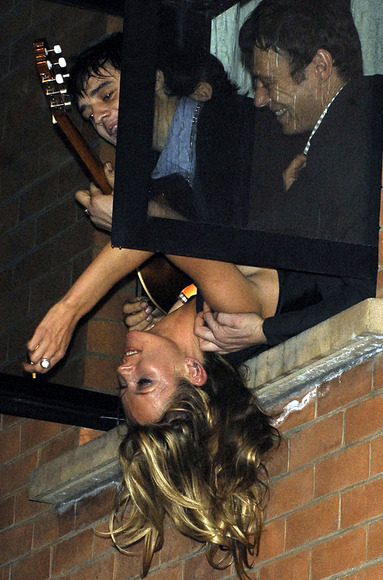
 Did someone say 'heroin chic'? I can't get enough of this drugged-out couple with their bedraggled couture. I love Kate's style at any given point from 1990 to around 2007, and her and Johnny Depp were amazing, but Kate and Pete really do it for me. The two of them constantly looked like they just emerged from shagging one another senseless, only taking breaks to snort coke, in the sexiest way possible and were now on their way to a concert. Kate's constantly rumpled hair, Pete's disheveled clothes, their devil-may-care attitude, their clear love for one another, it was absolutely perfect. Not that I particularly aspire to being the drug-crazed girlfriend of a rock star, but I feel that emulating bits of this careless style isn't a bad thing. Pete has always been one of my favourtes with his inspired combinations of formal and ragged (Guards jacket and converse, suit jacket and jeans) that he pulls off so well, but combined with Kate's ability to wear anything (or nothing) and look like a goddess (or a bacchian divinity in this case), it was just too much. Kate also prompted Pete to model for the 2007/2008 Roberto Cavalli campaign, in a series of photos where he looks ridiculously handsome. I also definitely picked up the idea of wearing loose ties over casual clothes from Pete.
Love and decadence.

David Bowie 
Bowie's typical genius for pattens and colours (the chair doesn't count)
It's impossible not to admire David Bowie's many styles. I cringe with embarrassment when I think of the amount of glitter, eyeshadow, and lipstick I have experimented with as an homage to Ziggy Stardust. Bowie transformed himself so many times that few people now know what he looked like originally: a scrawny, weird-looking short guy with crooked teeth and mismatched eyes. And this guy managed to convince the entire world that he is a sex god, multiple times in multiple guises. Whether as the effete ultra-hippie of the early 70s, the glam space invader Ziggy Stardust, the icy and impeccable Thin White Duke, the kitsch mega-star of the 80s, or the almost post-modern enigmatic artists that he has been since the early 90s, David Jones has never been David Jones. We will never know who he really is, but that doesn't matter. What matters is that Bowie knew the importance of appearance and used it as his greatest tool in his fame, manipulating image with superlative success. He not only worked with top designers, he designed his own clothes, did his own makeup, always with an incredibly astute sense of style. He also 'grew into' his face, I will always maintain that Bowie was vastly more attractive in the 90s than the 60s.
Bowie not afraid to look a little... um... eccentric.

Anouk Aimée
She's sort of my Audrey Hepburn. For me, she embodies the light, alluring, utterly European elegance even more than Audrey does. Even though she is French, I first saw her in the role she is probably most famous for, as the wealthy Maddalena in La Dolce Vita. In contrast to the blonde and overflowing Anita Ekberg, Aimee looks restrained, independent, intriguing. In every way, she is inaccessible and delightful. Her ambiguous yet sensual presence onscreen is enhanced by full hair, huge, emphasized eyes, and slender figure in simple, lovely clothes. Felini was inspired to make the film by women's sack dresses which he saw as endlessly suggestive, and perhaps no one embodies the spirit of those obscuring/revealing garments better than Aimee. For some reason, the most enduring part of her role in La Dolce Vita for me is when Maddalena listens to Marcello's declarations of love from another room, suddenly stops answering and leaves with another man. It is impossible to tell when her expressions are sincere, where the game ends and reality begins.
The above-mentioned scene in La Dolce Vita
Brett Anderson 
Brett flaunting what's he's got
 Being a tall girl, not particularly curvacious (shall we say), a lot of your fashion icons wind up being male. If you also happen to be poor and can only afford one leather jacket and second-hand tops (like me), Brett Anderson is a great fashion icon to have. During the early 1990s, Brett wore the most subtly androgynous, flattering outfits that were somehow very seductive without being outrageous. His clothes, bordering on trashy, loudly called attention to his best features, which were a surprising and unorthodox assortment; the curve of his back, the strip of skin between his belly and hipbones, the prominent cheekbones and jawline. Basically, I think I learned from Brett is that you can be sexy without catering to stereotypes.
None of this should work... but somehow it does
Babara Stanwyck and Myrna Loy
These two actresses are for me the best representations of a certain kind of early 30s glamour, the pre-femme fatale; hard as nails and beautiful as diamonds. They wore simple, flowing clothes, draped with unbelievable elegance. Their hair was perfectly set. Their faces showed a cool, sneering indifference. Their makeup was subtle and unobtrusive, yet made their faces positively blossom. Their unruffled look combined with their tough attitude make their stock characters one of my favourite Old Hollywood 'types'. Unlike the femme fatales in film noir, they are often unrepentant and/or unpunished, especially in pre-Code films such as Baby Face, which may be my favourite Barbara Stanwyck feature, her character as hard and cruel to the world as it is to her.

Karen Elson
Karen Elson by Steven Meisel for the Vogue Italia couture supplement, March 1997
 My favourite Karen Elson look is her breakthrough one from the early 90s (photographer Steven Meisel's invention) when she looked like an alien; bizarrely short crop of violently red-dyed hair, shaved eyebrows, milk-pale skin, exaggerated makeup. She kept the look for quite a few years. Her almost intentionally unsightly appearance was a slap in the face to any commonly held standards of feminine beauty. It was as if she was supposed to look hideous and instead looked like an outre vision from an alternate universe. Once she grew back her hair and eyebrows and started looking like a human being again, Karen lost most of her appeal for me.
Karen Elson by Craig McDean for the Vogue Italia couture supplement, March 1999
Mick Jagger
In the early 70s, Mick Jagger generally looked like a glittery, slutty trashcan. No one (including Bowie) before or since has done glam better. Mick had everything; the filthy crossdressing of the New York Dolls, the subtle aggression of Lou Reed, the insane 'dangerous glitter' of Iggy Pop, the alien genderless super-sexiness of Ziggy Stardust, the outrageous clothes made of priceless material, the buckets of glitter smeared on his chest, the makeup, the shining, jingling belts and jewelry, the leather, the lace, you name it. For me, Mick exemplified glam and the combination of a million different influences that make trashy so hot. Besides this, he was also a style icon since the early 60s and personified the decadence and drugged-out madness of the end of that decade. If anyone set the style, it was Mick Jagger.


Wednesday, February 11, 2015

Suede: all that's best of dark and bright

Super-British Suede: Brett Anderson on the cover of Select Magazine, his trademark ca 1992/1993 look in place; side swept fringe, gorgeous facial structure, showing off his hipbones.
I consider Suede an extremely elusive band. Their sound and charm evades description just as the band failed to achieve permanence. Their glory blazed and burned in a few brilliant years in the early 1990s and two stunning albums. Brett Anderson starts off 'Heroine' off Dog Man Star with a Lord Byron quote, 'she walks in beauty like the night.' Perhaps the best way of describing the band is from further on in the poem; 'one shade the more, one ray the less/had half impaired the nameless grace...' For one perfect moment, Suede were the best. For one perfect moment, they had all the energy, passion, emotion and expression that tapped directly into the frenzy and alienation of youth. And for that moment, I absolutely adore them.

 
Suede play 'Animal Nitrate' at the Brit Awards in 1993 in one of the most famous moments in TV music performance history. The power and aggression of the live rendition makes the album version sound utterly lifeless.

I might be the only fan of Suede who likes their eponymous debut album better than Dog Man Star. With mere reason, I know quite clearly that Dog Man Star is the superior album, but my heart belongs to the self-titled gem. Dog Man Star is a magnificent opus, but it lacks the freshness, the enthusiasm, the charm of the first album, perhaps even a sort of innocence. Suede has the infectiousness that defines rock's greatest debut albums such as Up the Bracket and Is This It. Edith Wharton once wrote that everything about a novel is encapsulated in its first paragraph (or something to that effect). Everything about Suede is encapsulated in their first album, it holds the clue to everything they would later do. It has the almost melodramatic wails of 'Sleeping Pills' and 'Pantomime Horse', the swampy lure of 'The Drowners' and 'So Young', the punk aggression of 'Animal Nitrate', the melancholy of 'The Next Life'. But mostly, Suede is an album I can relate to, while Dog Man Star I can admire, and admire from a distance. I might also be the only Suede fan currently residing in the city of Chicago. Unlike 90s British bands such as Oasis, Blur, and the Verve, Suede never made it big in America. It often seem to me that there is a distinct correlation between the lack of quality of bands and their popularity in America.

I tend to think of Britpop as the accidental child of Suede and Pulp that they both decided to give up for adoption. Both bands have denounced the movement and rejected their affiliation with it. Suede especially are credited with unintentionally inventing Britpop with their first album, while Pulp's 'Common People' is considered the ultimate Britpop anthem. Both bands (like all the best bands) transcended their allotted 'genre', leaving it for the Beatle plagiarists Oasis and train wreck of Blur to champion Britpop. The primary reason Suede were supposed to have 'created Britpop' is that they were so uniquely and quintessentially British. It is probably that they were unintentionally British to begin with, seeing as they knew no other life. Almost none of their musical roots can be traced back to America; they started out as a Madchester-sounding somewhat 'jingly' guitar band (check out one of their first recordings, 'Be My God') and their primary influences were the Smiths and Bowie. Brett Anderson often stated in interviews that he sought to capture ordinary life as he saw it, whether it be friendships, drugs, or sex and clearly the life he saw was exclusively British in character. No one in America would ever write songs about romantic, desperate, drug-induced, sexually deviant love in suburban council flats. Desperate, drug-induced fucking in deserted parking lots, maybe. There is something especially British in Suede's grandiosity, their poetry, their ambition. It's that spark of Romanticism that made the Libertines so incredibly appealing.

 'The Drowners' music video: probably everything you have to know about Suede. Brett's hair and flouncing honed to perfection.

My reasons for my fondness for especially Suede are in many ways uniquely personal. I was born and raised in the Moscow equivalent of a British council estate, and I can't help thinking of the atmosphere of urban dreams and urban poverty when I hear their music. I remember being forced to read Simone de Beauvoir's gigantic feminist bible The Second Sex on at least two separate occasions in college (thankfully only in parts) and being completely confused by this sentence; 'But if I wish to define myself, I must first of all say: "I am a woman"; on this truth must be based all further discussion.' I wasn't very receptive to the thousand or so pages of 'further discussion' because I just could not relate to thinking of oneself first and foremost as a gender. Imagine my delight with Brett Anderson quotes such as 'I'm naturally quite an effeminate person... not all the time' (from this 1994 article) and 'I just don't feel I'm a fully fledged member of the male sex...' (here). Not subscribing to a set of gender roles or even having a strictly defined focus on one's gender was something that I can relate to and come across very rarely.

Also, let the truth be spoken; Brett Anderson was gorgeous. And he knew it and played with it shamelessly. He wore flouncy blouses onstage that he let the audience tear off his body. His clothes always showed a strip of skin from his belly to his prominent hipbones. He let his hair fall over half his fine-boned, sensitive face then threw it back again. He somehow managed to slap his own ass during his bizarre dancing. He turned his back to the audience, showing off his beautifully curved spine and graceful movements. He was alluring, provocative, charismatic. His androgyny was mostly a matter of skillful presentation. For those who haven't noticed, women's bodies tend to be portrayed in popular media as passive, smooth, lush, and quiet, while men's tend to be shown as rough, aggressive, and strong. Even though Brett was by far not the most outrageously androgynous rock star (he never wore makeup for instance), he consistently presented himself the way women are popularly portrayed; luscious, smooth, graceful, almost passive.

Brett Anderson's attitude towards gender and sexuality was constantly the talking point in interviews. On further investigation, I discovered that his famous 'I am a bisexual man who has never had a homosexual experience' statement was in fact a misquote. Apparently he said, speaking of songwriting that 'I feel like a bisexual man etc.' which is quite different. He seemed to be obsessed with the idea of living through various potential and/or imaginary experiences, and combined with his cheeky evasiveness in interviews, this made him very open to misrepresentation. The media was completely unable to process the idea that Brett was writing from multiple points of view and describing non-autobiographical experiences. Brett's ambition of experiencing as many facets of life as possible unfortunately wound up leading him down the path to heavy drug use and later addiction, which destroyed the band's promise.

Brett showing off his lovely figure and his charming long-in-the-front-short-in-the-back haircut
Suede's sense of drama is incredibly admirable. In an interview, Brett talks about the first Smiths song he heard, 'What Difference Does It Make?'; 'the line that got me was "but still I'd leap in front of a flying bullet for you"... It's inches away from being a cliche, but it's so straight and so beautiful...' Inches away from being a cliche is basically a great way of describing a large portion of Suede's lyrics. And at times they're utter nonsense ('don't take your life 'cause your bicycle won't fly'). Why do they work? Most definitely the combination of Brett's fantastic vocal range and genuine emotion with Bernard Butler's spectacular guitar playing. Written on paper, some of Suede's lyrics would make one scream, but the pathos, the raw emotion in Brett's voice elevates them immediately into the realm of indisputable truth and power. It took me a while to realize that the band's first single 'The Drowners' is admirably lacking in all lyrical content (except for the suggestive 'do you believe in love there?' written down the narrator's spine) and mostly depends of Brett's outrageously exaggerated Cockney 'stop taking me ah-vahr!' Continuing on the subject of the Smiths, Johnny Marr's influence is felt all over Bernard Butler's playing, but no one could say Bernard is not an original. It is as much the emotion of his guitar playing as the strength of Brett's singing that carry the songs, for who can help listening when lines such as 'have you ever tried it that way' are accompanied by that brooding, oozing guitar?
Brett and Bernard right before the split.
 In conclusion, Suede were perfect. Listening to their early output, it's easy to forget the years of drug abuse, bad records, and regrettable haircuts that came later, and pretend like everything is at high tide forever.

Here are some great links for more Suede stuff:
  • Love and Poison: the 1993 concert film in pretty good quality, shot by W.I.Z., the camera work is a little hyperactive and distracting and the audio is missing for some of the songs (replaced with the album versions) but overall definitely worth watching. I feel a personal attachment to this because the performance was at Brixton Academy, where I saw Jack White two years ago.
  • Great blog of Suede live recordings and demos.
  • Interviews and articles posted by ORTRUDA on tumblr.
  • Live performances uploaded by jarvizcocker on youtube (also some great Pulp stuff! Please ignore Blur)

Wednesday, December 17, 2014

Review: London: The Biography by Peter Ackroyd


 You know when you can just tell that someone loves something or someone so fucking much by the way they talk about it? I've rarely read anything that conveys love as strongly as Peter Ackroyd's "biography" of London does for that city. I also have never cried over a non-fiction book before. This is easily the most impassioned, poetic, fascinating history of anything I have ever read. I have for some time been searching for a decent history of England or London, but have gotten bored a few pages into every book I found. When I stumbled across this book at a random shop, I was immediately intrigued. This is not at all a chronological, ordered history, but a collection of quotes, research, and observations about various aspects of life in London during the last two thousand years. I'm still searching for that absorbing history of England/London that is going to lay out the rulers, wars, uprisings, laws, etc (recommendations, anyone?) but until then, this is the book to crown all history books that I've yet encountered.

The book is divided into chapters on various subjects, each one discussed chronologically. The subjects range from the expected (the building of the city, the influence of the river) to the utterly unusual (the fogs of London, the food, the problem of waste matter). The very colour of the London skies is thoroughly explored. The smells, the sounds, the atmosphere of every age are conveyed so well that the book is basically next door to stepping into a time machine. The majority of the chapters deal with cultural subjects and their evolution throughout the history of the city; such as drinking, superstition, entertainment, speech, etc. Ackroyd uses multiple quotations from many of London's most famous citizens, such as Wordsworth, Charles Dickens (inescapable in London), Samuel Johnson, and Virginia Woolf. Not least in the many descriptions of the city is Ackroyd's own evocative prose. He traces parallels and patterns with enchanting observations; for instance, he talks about how workmen laying telephone cables underground had to go through the buried ruins of a Roman villa so that the conversations of the current citizens pass through the ancient rooms where a different language was spoken thousands of years ago by citizens of quite a different London. He also collected an astonishing array of comments, correspondences, and observations about London from people throughout history who are either unknown or anonymous. How he managed to assemble this I cannot even imagine. It feels like Ackroyd has read every word that has ever been written on the subject since the city was founded, and even some that weren't.

Punch or May Day by Benjamin Haydon, used by Ackroyd to illustrate the riotous life and entertainment of the London streets in the early nineteenth century.
 
Ackroyd is very interested in tracing the continuities of the city. He stresses that London can never really be known fully, there will always be street unexplored, places unseen, secrets hidden, as the city continuously renews itself, parts of it vanishing and reappearing in endless cycles. He is traces how certain locales have had the same sort of activities associated with them and people living in them; a long history of radicals in Clerkenwell, theaters around Blackfriars, etc. but seems to get a little too carried away in speculation about whether or not it is something about the areas themselves that encourages these continuities. His enthusiasm does seem to border on excessive at times, for instance it's hard to tell whether or not he is actually serious in his speculations about the influences of magic, pagan worship, etc on the history of London, or he is merely observing and noting superstitions. Of course it is most probably the latter, but I found his earnestness at times too overwhelming.

London from Southwark, ca. 1630. Ackroyd pays a great deal of attention to the architectural similarities and differences between the ancient, medieval, and modern cities.
The amount of fascinating anecdotal information is enormous. If I tried to talk about even half of it, I would probably break the internet. But here are a couple of really great things I learned. Apparently, the "foggy London" of Victorian times was not at all what we see now. The nineteenth century, especially from the middle to the end of the century, had a most peculiar, dense fog that is incomparable to the present-day fairly benign occurrence. The fog could be any of a variety of shades (yellow, brown, black), blocked out daylight, and was the cause of a great number of traffic accidents. It was partially caused by the excessive use of coal, but was partially a natural phenomenon. There is a plane tree at the corner of Wood Street and Cheapside that has existed longer than living memory, no one knows its age and it continues to flourish today. In medieval times, when the Thames froze over, fairs used to spring up on the frozen river, with sometimes disastrous results when the thaws started (before reading this book I thought Virginia Woolf had invented this in Orlando).

The tree at the corner of Wood Street that has been flourishing for hundreds of years.
Ackroyd's love for the city is passionate and unflinching. He looks at all aspects of the city; from the glorious to the horrible, from the eternal to the fleeting, and embraces them all. He presents the desperate poverty of the slums and the cruelty of the prisons alongside the tales of stoical, almost celebratory communal spirit during the Blitz. He treats London as a living being, one that not only has not a history but a biography, and one that he loves while knowing the worst of it as well as the best. Perhaps he romanticizes London at times, but as someone who has lived there, there are few impulses I sympathize with more strongly. London, of all cities, is worthy of being romanticized. I really cannot praise this book highly enough, its combination of well-ordered, fascinatingly presented information and passionate, poetic writing is truly unique in my experience.

Friday, December 12, 2014

Review: David Bowie Is

When the David Bowie Is exhibit from the Victoria and Albert Museum arrived in Chicago for its only US stop, I was very excited, mostly because the Victoria and Albert was one of my favourite museums in London. When I lived there, I basically moved into the V&A for the weekends when I was not working. To me, it is one of the most informative and fascinating places in the world. I learned more in the time I spent there than I did in a year of university. And of course, I was excited about the subject matter. I've always been a Bowie fan, but never a mega-fan. I managed to acquire quite a lot of knowledge about him through reading about other bands and artists, but was not specifically interested in him or his music, nor did I care to explore beyond the usual glam standards. I was always more attracted and intrigued by his style and provocative antics than the music. Bowie himself did not help out with the exhibit, he merely gave the organizers access to his extensive archive in New York, only a fraction of which is represented by the exhibit. I went into the exhibit with the expectation of learning a lot about Bowie and his influences on culture and get really in-depth information about the writing and recording of his music.

David Bowie doing his spectacular makeup during the Ziggy Stardust tour

The visual experience was immediate and is almost overwhelming. Some of Bowie's most famous costumes are there; the quilted suit from the Top of the Pops performance of "Starman", the hilarious little romper suit decorated with rabbits, the "Life on Mars?" powder-blue suit, the clown outfit from the "Ashes to Ashes" video, the beautiful knitted jumpsuit from the 1970s that Kate Moss modeled for Vogue in 2003, and a million other beautiful capes, suits, and other dazzling outfits. It's basically worth the price of admission to see the clothes, especially those designed for Bowie in the 70s by Kansai Yamamoto (part of an interview with whom about his work with Bowie is shown). The fabrics are so beautiful that you just want to touch them and the prints are dazzling. I have no idea how the clothes have kept so well all these years; their colors are still as fresh as if they were made yesterday and they show almost no signs of wear. Great costumes from the 90s include the coat that Alexander McQueen designed for Bowie for the Earthling album cover and, my personal favourite, a distressed "frock coat" that Bowie designed himself for his 50th anniversary, an extravaganza of stunning fabric, ornate collar, and stylishly emphasized waist. There is also the hilarious, enormous "dress" (an imitation of a German cabaret act) that Bowie wore for a Saturday Night Live performance of "The Man Who Sold the World" in the late 1979, which was actually a prop he had to be encased in like a sarcophagus and bodily picked up and put into place because he was utterly immobile. I could probably go on about the costumes all day.

Bowie in the 1970s, wearing one of the Kansai Yamamoto capes on display at the exhibit

50th anniversary "frock coat" designed by David Bowie, 1997

Other items on display were also fascinating; Bowie's paintings from his stay in Berlin, lyrics, sketches for stage shows (by both Bowie and others), a very feminine-looking makeup layout that a makeup artist made for Bowie in the 1970s, seeing as he usually did most of his own makeup, photographs, etc. Some of the items feel a bit too personal, such as a cocaine spoon ca. 1975 and a tissue blotted with lipstick from the Ziggy years (who on earth saved that?!) but for the most part, they are things that are pretty awesome to see firsthand. One of my favourites was probably the handwritten lyrics to "Rock 'n' Roll Suicide." I might have gotten a bit emotional staring at them, wondering how Bowie must have felt writing them all those years ago. The whole exhibit concludes with a room screening various performances across the years, my favourite was the vivid, outrageous montage of 70s footage (mostly from the Ziggy Stardust tour) to "Rock 'n' Roll Suicide", but the three simultaneously played versions of "'Heroes'" was curiously uplifting. I really can never resist the moving appeal of that song. Not that I try very hard. The exhibit is also accompanied by various talks and performances (most of which have already happened), but the amazing Annie Clark (St. Vincent) will be giving a talk about Bowie on January 3 (it is sold out though).

However, I didn't get exactly what I hoped for. I am a naturally very negative person, finely tuned to pick up what is wrong with every situation I encounter, so I immediately noticed a million things I disliked. First of all, the exhibition labels have obviously been rewritten from the original exhibit, and need an editor so badly I wanted to scream. Their content is completely uninformative; one label, commenting on the Ziggy Stardust persona, simply contents itself with printing the lyrics to the eponymous song, as if anyone who walked into an exhibition devoted to Bowie somehow did not know it. Another label informed me that D.H. Lawrence's Lady Chatterley's Lover initiated the relaxing of censorship in the 1950s when the ban on its publication was lifted in 1960. I stopped reading somewhere around the second room. It's also not somewhere you can go to with your friends. This was not a problem for me, because I went alone, but seriously, don't bring your friends. The exhibition is accompanied by a headset that responds to your location, so you can hardly have a conversation. (The headset sometimes gets confused and is rarely helpful, "Diamond Dogs" played on a loop wasn't a highlight for me, I happened to have heard the song before I came). This probably accounts for the ridiculously high price ($25/person). Getting back to the labels, not only are they unhelpful and jumbled, many are painfully trite. I cannot remember the exact wording, but one emphasized how Bowie's work encourages his audience to be whatever they want to be, explore and embrace themselves. Does this really need to be shoved in our faces in this infantile manner? Another thing that is presented inaccurately was Bowie's sexuality. The labels clearly make it seem, without explicitly saying so, that Bowie was gay. Now, I love how accepting Chicago is of gay culture. It's a major part of the city, Boystown famously being the first recognized gay neighborhood in the US. However, this is no reason to twist facts. No allusion is made to the fact that Bowie was married twice and is, very probably, completely heterosexual. Attention is called, instead, to the famous interview in Melody Maker in which Bowie declared that he was gay, and the "homoerotic stageplay" between Bowie and Mick Ronson. Most of the videos and photographs on display are things that almost any Bowie fan has already seen (such as the Thin White Duke "archer" photo and the "Starman" live performance), while I had really hoped for some archive footage and recordings. Unsatisfyingly small glimpses of both are given in the last gallery. The primary focus is on the period of Bowie's early youth through about 1980, everything else (such as the spectacular 90s albums) gets swept hastily out of the way, but I suppose we can't have everything.

A beautiful example of "homoerotic stageplay" from the 1970s, Bowie and his guitarist Mick Ronson
Having said all of this, I walked out of the exhibit with a mostly positive response. I learned a lot, but maybe not the things that I expected. I really wanted to know more about the songwriting process, and maybe have more interviews with Bowie and quotes from him, but the exhibit focused more on influences and things Bowie was interested in. Which it turned out I knew very little about. I had no idea about Bowie's fascination with Japanese kabuki theatre, and how it influenced his stage shows. I also did not know that Bowie was originally into mime (the late 60s performance called "The Mask" is hysterical!) or that he read very extensively (I got a lot of book recommendations from there, check out this list of Bowie's top 100 books), the works of sci-fi writer J. G. Ballard with their space-age themes being prominently emphasized. Also news to me was Bowie's starring in a Broadway production of "The Elephant Man." I had really previously underestimated Bowie. I came away with the impression of an immensely well-informed artist, who crafted his own image with purpose, intelligence, and creativity. The exhibit title, which I originally thought pretty silly, is in fact very appropriate for an artist whose creativity is literally expressed through self-generation. I did not walk out with any very clear idea of who the fuck David Bowie is, but I certainly walked out with a new respect for his work, his ability to integrate various art forms and try everything, to take risks. I also got the impression of someone who has a tremendous sense of humour about both himself and his audience. I'm not sure why, but I felt like Bowie kind of half manipulates us and half lets us in one the joke.

General information about the exhibit:
David Bowie Is, Chicago's Museum of Contemporary Art
September 23, 2014 - January 4, 2015
Price: $25/person ($15 for students with ID Tuesday - Friday)

The exhibit prompted me to listen to more Bowie and made me way more interested in him than I had bargained for. I've been listening to an enormous amount of his material of late, so he will probably appear here again soon. Very soon.

Thursday, December 11, 2014

Introduction

If I could, I would publish a magazine. One that has cool pictures and reviews of stuff and writing and quotes and recommendations, and general nonsense to brighten up life. As I have absolutely no financial means or chance to publish anything, I'm going to run this blog instead. I have, in the past, helped run a film blog for Facets, a Chicago-based cinema organization, but I'd like one of my very own. And it's free, so what the hell? I've lived in a few parts of the world, I'm not American but I currently live in Chicago and will soon be moving to London. I'm a music enthusiast, an Anglophile, fashion lover, I study English literature, particularly interested in medieval romances, Gothic fiction, and early twentieth century authors, I do art in my spare time, love going to concerts, exhibits, etc, watch a lot of old movies from various countries and British TV. I have very strong interests and preferences but mostly choose not to burden people in my life with them, so that's part of the reason for this blog. I probably won't post pictures of myself, but we'll see how it goes. I might be tempted to show off some outfits.

Things you will find here:
  • reviews/recommendations: music, books, movies
  • observations/photographs: places, fashion, art
  • quotes: poetry, favorite authors
  • general comments on a variety of subjects
The title of the blog comes from the traditional English ballad (one of the Child Ballads) "Thomas Rymer and the Queen of Elfland" in which the queen of Elfland points out the "bonnie road" to "fair Elfland." The header image is a lovely photograph of Trafalgar Square by w4lrusss on flickr.